
2025-2026 EDITION
THE STATE
OF HEAVY-DUTY REPAIR REPORT.
Get your free copy of the definitive report on the commercial vehicle repair industry, full of benchmarks, insights, trends, best practices, and more!
Download Free Report


ABOUT OUR REPORT
This report provides unmatched insights, trends, and benchmarks regarding the maintenance of heavy-duty equipment. We define the heavy-duty repair category as independent and internal shops focused on maintaining Class 6-8 vehicles, agricultural machinery, emergency vehicles, construction equipment, heavy machinery, commercial fleets, and more.
OUR METHOD
We analyzed user data from more than 900 individuals from the commercial freight, logistics, and repair industries; we also sampled more than 3,400 shops from across North America, Australia, and New Zealand for real-world shop data.
HERE'S A SNEAK PEEK:
How Often Do Shops Assess Their Labor Rate?
Just over half of responding shops assess their labor rate once a year, with 34% informing us they assess more than once a year. We admit we’re a little concerned about the 12% of shops who don’t look at their labor rate at all. You could be leaving money on the table!
What Is The Labor Rate Nowadays?
Labor rates have been steadily increasing over the last few years: the beginning of 2024 saw a median labor rate of $135, which jumped to $145 by early 2025 and now sits at $149.Interestingly, only 7% saw themselves as “expensive,” or more than $10 more per hour than their nearby competitors. A good portion of them (34%) saw themselves as less expensive ($10 or more less than nearby competitors). Some of the “more expensive” shops may also be working on different types of equipment, or doing additional mobile or emergency call-outs, and so on.

How do Shops Think Their Labor Rate Compares to Competitors?

34%
of respondents think their labor ratesare less expensive

46%
of respondents think their labor ratesare in line

7%
of respondents think their labor ratesare more expensive
Mobile Charges & Call-Out Fees
Mobile repair can be a lucrative service, but it also brings its own expenses; you’ve got to keep your service truck in good order and filled with gas, you need to keep a good stock of parts in it, and whatever tech hops into it to deal with a call-out is no longer going to be available for work that day.The median general labor rate was $145. The mobile median labor rate was $60, or 10% more than the general rate. In addition, almost half the industry implements an hourly trip charge for every call-out. Considering the wear and tear and additional expenses that go into running a mobile repair branch, that sounds more than fair.

Heavy-Duty Longevity
Heavy-duty might not be for everyone, but those who get into it can stay there for a long time — while the median years of experience is 17, a hefty 43% of our respondents had over 20 years of involvement! Fun bonus: the most experienced respondent told us they’d been in the field for 57 years.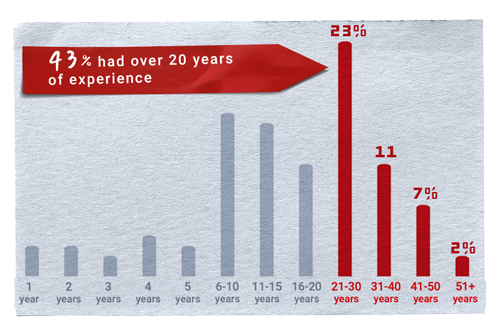
Parts Markup & Margin by Region
So, does geography influence how shops approach parts pricing and margins? It sure does. Here’s how the numbers have shifted across the United States and Canada from 2025 through 2025.
How do shops recruit new techs?
Folks, we’ve got a tie! Shops turn most frequently to Google Ads and Facebook when they advertise their operations. Next was word of mouth and Search Engine Optimization (SEO). Note: Respondents selected all that applied for this question.
57%
recruit through Google Ads
57%
recruit through Facebook
50%
recruit through word of mouthIn Conclusion:
The Heavy-Duty
Industry Is
Here To Stay.
Regardless of what happens with alternative fuels and power sources, there will always be a need to transport and construct — and a need for technicians and shops to repair the machinery that makes it happen. That’s not to say the industry won’t see changes and shifts, particularly as the old guard continues to retire and the search for newer and younger techs continues. We hope the trends we’ve showcased here can help you grow and update your own shop.
A Special Thank You
To Our Partners:



Ready to take a deeper dive?
Get your free copy of the definitive report on the commercial vehicle repair industry, full of benchmarks, insights, trends, best practices, and more!
ALL EDITIONS:
EBOOK
2025-2026 EDITION
Check out the most current commercial vehicle repair industry report, full of benchmarks, insights, and best practices. DOWNLOAD NOW
EBOOK
2024-2025 EDITION
Curious about past years' trends? Check out the 2024-2025 commercial vehicle repair industry report. DOWNLOAD NOW
EBOOK
2023-2024 EDITION
Curious about past years' trends? Check out the 2023-2024 commercial vehicle repair industry report. DOWNLOAD NOW
EBOOK
2022-2023 EDITION
Curious about past years' trends? Check out the 2021-2022 commercial vehicle repair industry report. DOWNLOAD NOW
EBOOK