Trailer Inspection Checklist for Fleets: How to Build a PM Program That Doesn’t Get Skipped
Summary
A trailer inspection checklist only works if the program around it does too. That means assigning a named owner to every trailer, backing up mileage triggers with calendar-based checks, and running inspections on a four-tier cadence through an annual DOT-aligned inspection. Reefers need their own track, and overdue PMs need the same visibility as an overdue truck.
Most trailer inspection checklists tell you what to check. Tires, brakes, lights, coupling — fine, sure, nobody’s arguing with the list. What they don’t tell you is why the list keeps not getting followed, even at fleets that printed it out, laminated it, and hung it on the shop wall.
We covered the why in detail here. The short version is that trailers don’t misbehave the way trucks do, so a preventive maintenance (PM) program built around truck habits can fail them. This piece is the fix: the program structure that actually makes a checklist stick, with the checklist itself included below.
Give Every Trailer an Owner
A PM policy that applies to “all trailers” is a policy that applies to no trailer in particular. Assign an actual owner — a person or a role — to every unit in the fleet. Not “maintenance is responsible for trailers” in the abstract. Somebody’s name, tied to specific trailer numbers, who gets asked directly when one’s overdue.
This matters most at the handoff. A trailer that gets dropped at a customer dock, picked up by a different truck, or interchanged to another carrier is a trailer that can slip out of anyone’s field of view, which is exactly the failure mode maintenance teams describe when things get busy and something isn’t clearly flagged in the system. Ownership has to survive the handoff, on paper, with a clear answer to “who’s responsible for this trailer right now” at every point it changes hands.
Fix the Trigger, Not Just the Checklist
Mileage-based PM intervals work fine for a truck tied to one driver’s logs. They fall apart for a trailer that gets swapped, dropped, and re-hitched across a fleet, because the mileage record gets fuzzy fast. Picture a 40-trailer drop-and-hook yard where half the fleet hasn’t been behind the same truck twice in a month. Mileage stops meaning much as a trigger at that point. That’s really an argument for leaning harder on time-based PM for trailers specifically, instead of treating mileage as the only thing that counts.
A calendar-based backstop is the simplest fix: every trailer gets inspected every 30, 60, or 90 days, regardless of mileage or movement. It catches the units sitting in a yard racking up zero miles and zero attention. In a lot of fleets, that describes more trailers than anyone would like to admit.
Hubodometers help too. GPS-based trailer telematics do a fancier version of the same job, though not all trailers on the road actually carry a telematics device. Most fleets already know the technology exists. The real gap is installation and follow-through.
Better yet, tie the inspection trigger to something your system already logs instead of a person’s memory, such as a yard check-in, a load assignment, anything that happens automatically. None of this replaces the checklist below. It’s what makes sure the checklist actually gets opened.
The Checklist, By Cadence
This is built for commercial fleet trailers — dry van and flatbed primarily. Reefer trailers carry their own refrigeration unit with a separate PM schedule and typically need a tech with an additional certification; treat that as its own track.
Daily / pre-trip
- Tires — pressure, tread depth, visible damage
- Brakes — application test at hookup: listen for proper release and application, check for obvious drag
- Lights and reflective tape
- Coupling device / kingpin condition
- Landing gear operation
Monthly
- Wheel-ends and bearings — oil level via sight glass or grease condition depending on hub type, seal leakage, play when the wheel is rocked
- Suspension — springs, air bags, mounting hardware
- Structural — cross-members, floor condition, frame rails, rear impact guard (ICC bumper), mud flaps
Quarterly
- Brake stroke measurement (confirming the automatic slack adjuster is holding proper stroke, not manual adjustment) and lining depth
- Electrical system and wiring harness condition
- ABS function — power-up self-test lamp sequence, and blink-code diagnostics if the system flags a fault
Annual (DOT-aligned)
- A full inspection matching 49 CFR §396.17 requirements — brakes, coupling devices, frame, suspension, tires and wheels, electrical/lighting systems, and rear impact guard condition per §393.86
- Performed by a qualified inspector, documented, and retained for 14 months
- Each vehicle in a combination is inspected separately — a tractor-trailer combination needs two separate annual inspections, not one
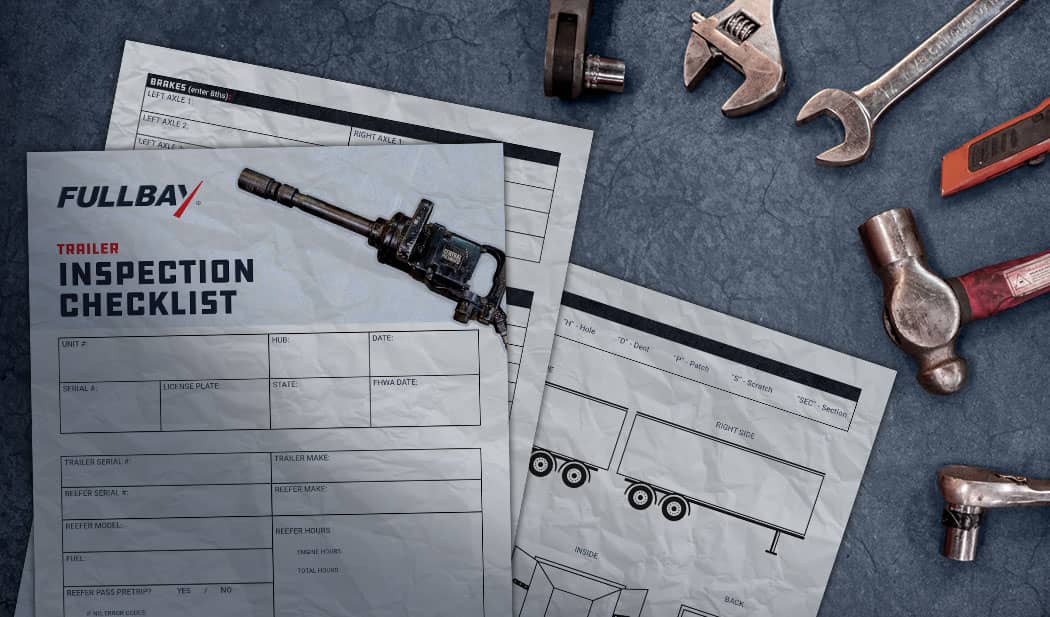
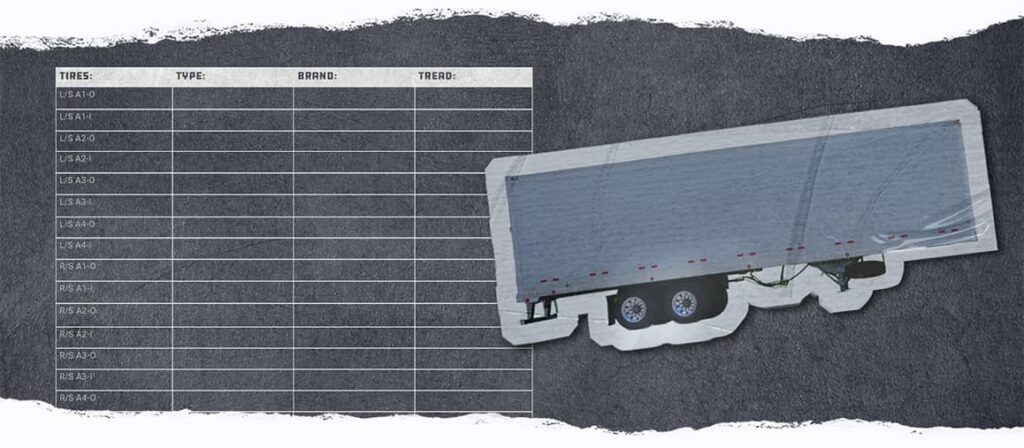
If your team works better from a physical document than a bulleted list, we’ve also got a printable trailer inspection form — space for tire tread and brake stroke by position, a full damage diagram, and driver/inspector sign-off. Handy to keep in the truck or clipped to a board in the shop.
Make Skipping Visible
Most checklists skip the part where a trailer’s PM comes due and nobody does anything about it. At most fleets, the honest answer to “what happens then” is: nothing, for a while. Truck PM tends to live somewhere visible, like a maintenance manager’s dashboard or a dispatch hold. Trailer PM often lives somewhere less visible, and that is exactly how it drifts for weeks without anyone noticing.
Give overdue trailer PM the same teeth overdue truck PM already has. Dispatch shouldn’t be able to assign an overdue trailer without logging an override and a reason. Overdue units should surface automatically in a manager’s daily view instead of sitting in a report nobody opens. And ideally it’s the same system already being watched for trucks, not some separate, quieter, easier-to-ignore lane where trailers go to be forgotten.
Set an Escalation Path
Missing one PM is usually just a scheduling slip. If the same trailer, or the same yard, keeps showing up on the missed list, that’s no longer an individual mistake — it points to something broken in the process itself.
A simple structure works: the first miss triggers an automatic reminder to the assigned owner, no manager involved yet. A second miss on the same unit goes straight to the maintenance manager. But once misses start piling up across multiple units at one location, that’s not an individual accountability problem anymore. It means something about that location’s workflow is broken, and writing up the same person again isn’t going to fix it.
None of this is complicated, which is sort of the point. A checklist tells a tech what to look at. Ownership, a working trigger, and a little visibility are what actually get that checklist opened on the day it’s due, not three weeks later when a trooper finds it first.
If your fleet runs its own in-house maintenance shop, this is basically the job Fullbay’s fleet maintenance software already does: PMs assigned to a tech, a documented history tied to each trailer number, and overdue units flagged before dispatch can quietly grab one.

Get news & tips right in your inbox.