
How to Hire Technicians: A Complete Guide for Repair Shops
Takeaways
If you only take three things from this guide, make them these:
- Be specific and fast in everything you do (specific pay, specific job details, fast follow-up, fast offers).
- Treat culture fit as seriously as technical skill during screening and interviews.
- Don’t wait until you’re desperate to start building relationships with trade schools and your own team’s network.
Finding qualified diesel technicians is hard. So much so that we can practically see you rolling your eyes and muttering “old news, Fullbay.” And we agree! You don’t need another article telling you there’s a shortage.
What you need is a hiring process that actually works: one that gets candidates in the door, helps you identify the right ones, and convinces them to choose your shop over the three other offers they’re weighing.
That’s what most shops get wrong. They treat hiring like a transaction: post a job, wait for applications, pick the best resume. In a market where skilled techs have options, that passive approach leaves you fighting over the same small pool of candidates as everyone else.
The shops that consistently hire diesel mechanics and keep them aren’t doing anything magical. They’re just more intentional about it. They’re the shops that know what technicians actually care about, and it’s rarely just money. They write job postings that stand out. They move fast when they find someone good. And they don’t stop recruiting just because their bays are full.
This guide walks through that system start to finish, from figuring out why candidates are ghosting you to onboarding them once they say yes. Along the way, we’ll point to some of our deeper dives on specific steps if you want to go further into any one piece of the process.
Why Your Shop Keeps Losing Good Candidates
Before we talk recruitment strategies, let’s diagnose the problem. Most shops are making one or more of these mistakes without realizing it.
Your job posting might be invisible to job seekers, living on one generic job board buried under hundreds of other listings. Or it reads like a legal document: walls of requirements, zero personality, nothing that tells a tech why your shop is worth their time. Maybe you move too slowly. That A-tech who applied Monday already had three other offers by Friday. Or you’re selling the job instead of the career, when techs want to know they’re not walking into a dead end.
And then there’s reputation. Word travels fast in this industry. If your current team members are burned out and complaining, candidates hear about it before they ever set foot in your bay.
The good news: every one of these is fixable. Let’s get into it.
The Real Reasons Diesel Technicians Take (or Leave) Jobs
Forget what you assume techs want. Compensation matters, but industry surveys consistently show it’s rarely the deciding factor. What actually separates shops that attract quality candidates from those that can’t fill a bay?
The Baseline Expectations
If you’re missing any of these, you’re not even in the conversation.
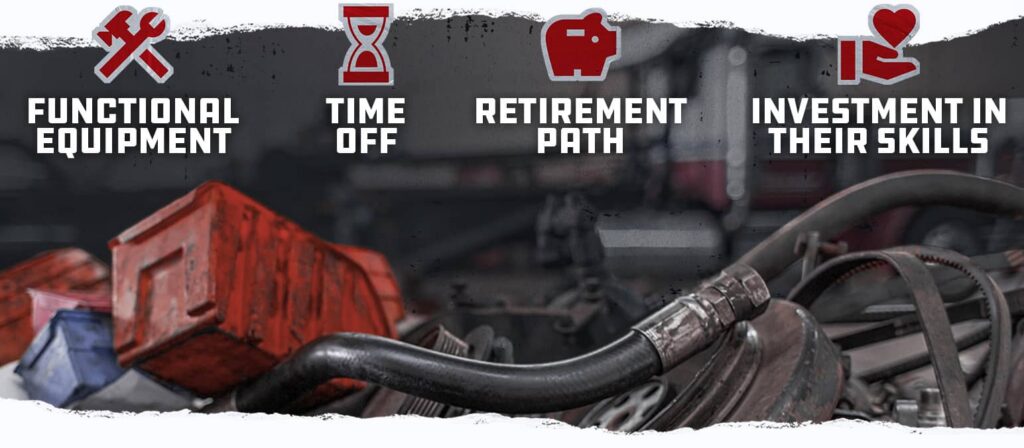
- Functional equipment. Techs talk. If your lifts are sketchy, your diagnostic tools are from 2003, and your parts room looks like a tornado’s personal storage unit, word gets out. Nobody wants to fight their own shop just to do their job.
- Time off that’s actually usable. Paid vacation isn’t a perk anymore, it’s expected. “Unlimited PTO” that nobody can actually take doesn’t fool anyone.
- A path to retirement. 401(k) matching signals you’re thinking beyond next quarter. For techs planning a 20-year career, that matters more than a signing bonus.
- Investment in their skills. Modern diesel engines are basically computers with wheels. Shops that pay for training and certifications attract technicians who want to stay sharp, and keep them from getting poached by the shop that will.
 What Makes Technicians Choose You Over the Shop Down the Road
These are the factors that tip close decisions. A predictable schedule beats higher pay with random weekend call-ins, because techs have lives outside the shop. Transparency about advancement matters too: can a B-tech become an A-tech at your shop, how long does that take, and what does it require? If you can’t answer those questions clearly, ambitious techs will find someone who can.
Physical environment plays a bigger role than many owners realize. Climate control, good lighting, and proper ventilation aren’t luxuries; they’re how you keep experienced technicians working into their 50s instead of burning out at 40. And tool support matters, whether that’s supplying tools outright, offering an allowance, or running a rent-to-own program, so techs aren’t drowning in debt just to do their jobs.
The bottom line: you’re not just competing on dollars per hour. You’re competing on quality of life. We go deeper on what keeps techs around, and what pushes them out the door, in our Technician Retention Guide.
Writing a Job Posting That Actually Gets Responses
Most job postings are terrible. They list seventeen requirements, bury the pay rate (if they mention it at all), and read like they were written by a committee that has never held a wrench.
Here’s the short version of how to write one that stands out. For a full breakdown of what to include and what to cut, see our post on the Do’s & Don’ts of Writing a Diesel Tech Job Post.
Open With the Hook, Not the Requirements
Your first two sentences determine whether anyone keeps reading. Don’t waste them on “We are seeking a qualified diesel technician to join our team.” Instead, lead with what makes your shop worth applying to:
“$32–38/hour depending on experience. Monday–Friday, no weekends. Full benefits start day one. Climate-controlled shop with new equipment.”
That’s a posting that gets clicks.
Be Specific About Compensation
Vague pay ranges are a red flag to experienced techs. They signal that you either don’t know what the job is worth or you’re hoping to lowball someone. Post real numbers. If you can’t commit to a range, at least explain your pay structure clearly.
Show What Daily Life Actually Looks Like
Generic phrases like “fast-paced environment” tell candidates nothing, because every shop claims to be fast-paced. What actually helps is specificity: what types of equipment will they work on, how are jobs assigned, who do they report to, what does a typical day look like. The more concrete you are, the better candidates can self-select, which saves everyone time.
Make the Application Ridiculously Simple
If your process requires creating an account, uploading a formatted resume, and filling out the same information three times, you’re losing people. Good candidates have options, and they’re not going to fight your application portal to maybe get a callback. Let candidates apply with a phone number and a few sentences about their experience. Collect the paperwork later.
Where to Post Your Job (Beyond the Obvious)
Throwing your job posting on Indeed and hoping for the best isn’t a recruitment strategy, it’s a lottery ticket.
Industry-specific job boards. General job boards bury mechanic jobs under thousands of unrelated listings. Platforms built for the trades put your opening in front of people who are actually looking for shop work.
Your own digital presence. Your website’s careers page matters more than you think, because candidates Google shops before applying. An outdated site with no information about what it’s like to work there sends people elsewhere. Photos of your team, details about your equipment, and clear job listings keep them reading.
Social media, done right. Posting “We’re hiring!” with a link doesn’t work. What works is showing your shop culture consistently over time, sharing completed jobs, celebrating tech milestones, and posting about your team’s wins, so that by the time you do have an opening, you’ve already built credibility. This is one of the most underutilized recruitment channels in the industry, and it costs basically nothing.
Trade schools and technical programs. Stop waiting for graduates to find you. Build relationships with trade schools before students are even job-hunting. That could mean guest lecturing, hosting shop tours, offering externships, or sponsoring a promising student’s tool fund. When those students graduate, your shop is already on their short list. Shops that partner with training programs on internships and curricula report vacancy rates 5.2 percentage points lower than shops that don’t, according to ATRI’s 2025 technician shortage research. If you’re recruiting straight out of these programs, our guide on How to Become a Diesel Mechanic covers what students and instructors are hearing about the field.
Your current crew. Employee referrals consistently produce better hires who stay longer, since your team members know the job, know your shop, and know who in their network would actually be a good fit. Make referral bonuses worth their time. Some shops offer $1,000 or more for a successful hire, and it’s still cheaper than months of recruiting and an empty bay.
Screening Candidates Without Wasting Everyone’s Time
Your time is valuable. So is theirs. And a good screening process respects both.
Before scheduling anything formal, make a five-minute call to confirm the basics: Do they have the certs you need (ASE, CDL, etc.)? Do they have hands-on diesel experience? Are they looking for full-time work on the schedule you’re offering? Any deal-breakers on either side? This call eliminates mismatches before anyone drives across town for an interview.
During that call and the interviews that follow, a few warning signs are worth digging into. Job-hopping isn’t automatically a problem, techs move around, but five shops in three years with vague reasons for leaving deserves a follow-up question. So does a candidate who blames every previous employer and coworker for everything that went wrong, or who dodges direct questions about references and work history. And pay attention to candidates who ask nothing at all about your shop. They’re not evaluating fit, they’re just looking for a paycheck, and that’s a retention risk before day one.
Culture fit deserves just as much attention as technical skill. A Fullbay customer put it bluntly during a panel discussion on hiring: “[If] you don’t fit in, it’s not gonna work.” His shop had learned that lesson the hard way after hiring a technically brilliant tech who couldn’t get along with the rest of the team.
Running Interviews That Reveal the Real Candidate
Interviews aren’t interrogations. They’re conversations designed to answer one question: will this person make your shop better?
 Test Skills in the Shop, Not Just the Conference Room
Resumes lie, and references can be gamed, but asking someone to diagnose a problem in your bay is hard to fake. Set up a practical assessment based on work you actually do: a straightforward PM inspection, a diagnostic puzzle where you plant a fault code and see how they chase it, or a repair task matched to their claimed experience level.
While they work, watch for safety discipline (do they grab PPE and check wheel chocks without being reminded?), systematic thinking (do they work the problem methodically, or guess?), and how they handle not knowing something. The best technicians admit when they’re unsure and ask questions. The ones who fake it tend to be the ones who cause the expensive mistakes.
One shop owner we’ve worked with uses an experience checklist during interviews, having candidates rate themselves honestly on specific tasks like DPF diagnosis or welding. As he tells applicants, “It is OK if you have no experience in these areas.” That kind of honesty upfront tells him more than a polished resume ever could. More on that approach in The Right Stuff: Questions To Ask When Hiring Techs.
Questions Worth Asking
Skip the textbook trivia. A question like “walk me through the last really tricky diagnosis you solved” tells you more about how a candidate’s brain works than any quiz on diesel engine theory. Asking how they’d prioritize three trucks down with parts for only one repair reveals how they handle pressure. And asking what skill they’re still working to improve says a lot about self-awareness. Candidates who claim to know everything are usually the ones who know the least, and who cost you the most down the line.
Character questions matter just as much, since technical skills can be taught but attitude is much harder to fix. Try asking about a mistake that cost the shop time or money and what happened next; you’re listening for ownership, not excuses. Ask what their last supervisor would say is their biggest weakness. And ask what made them leave their last shop, and what would make them leave this one. Understanding their triggers helps you evaluate fit and avoid accidentally recreating the exact situation they just escaped.
Reference Checks That Actually Tell You Something
Most shops either skip references entirely or treat them as a formality. That’s roughly equivalent to skipping the pre-trip inspection because the truck looks fine.
After the standard verification questions, ask the one that matters most: “If you had an opening tomorrow, would you hire them back?” A confident yes is a green light. Hesitation or hedging tells you what you need to know.
Beyond that, ask what types of work the candidate handled independently versus needing supervision, how they responded to feedback or correction, whether there were attendance, safety, or professionalism issues, and how they got along with the rest of the team.
Don’t take certifications at face value, either. ASE certifications can be verified online, and CDL status can be confirmed through state DMV systems. In an industry where safety matters this much, a few minutes of verification can save you a lot of very expensive regret.
Closing Candidates Before Someone Else Does
You found a great diesel technician. Now don’t lose them to a faster shop.
The best candidates are interviewing at multiple places, so speed matters. Make verbal offers within 24–48 hours of final interviews. And don’t go quiet in between: if your hiring process takes time, explain why and give candidates a timeline. “We’re finishing interviews this week and will have a decision by Friday” keeps people engaged. Radio silence sends them to the shop that was ready to make an offer on Thursday.
Use what you learned during the interview to shape the offer itself.
- If the candidate emphasized schedule flexibility, lead with your hours.
- If they’re focused on growth, emphasize training and advancement.
- If they mentioned frustration with disorganized shops, talk about your systems and processes.
A personalized offer shows you were actually listening, not just filling a bay.
Onboarding That Prevents Early Turnover
The first 90 days determine whether your new hire becomes a long-term team member or another turnover statistic, and turnover is expensive in both dollars and headaches. Understaffed shops experience turnover rates of 18.1% compared to just 7.8% at fully staffed operations, according to ATRI’s “Addressing the Shortage of Qualified Diesel Technicians” report. Bad onboarding is often what keeps shops stuck in that cycle.
Before a new hire’s first day, make sure their workstation is clean and assigned, tools and equipment are ready, login credentials exist, the first week’s schedule is clear, and someone specific is designated to answer questions. Nothing undermines confidence faster than showing up to a shop that wasn’t expecting you.
Once they’re in, resist the urge to throw new hires into the deep end. Week one should focus on your systems: how jobs are assigned, how time is tracked, how parts are ordered, how the team communicates. Weeks two through four can gradually increase in complexity, with clear checkpoints along the way. Pairing them with a patient, well-respected mentor, rather than whoever happens to have the lightest workload that week, makes a bigger difference than most shops give it credit for.
Regular check-ins at 30, 60, and 90 days catch problems before they turn into resignations. Ask what’s going well, what’s frustrating, what they need that they don’t have, and where they want to be in a year. Once these conversations become part of your rhythm, it’s worth formalizing them; our post on Technician Performance Review walks through turning them into an ongoing evaluation process. For the full onboarding checklist, including software setup and shop documentation, see The Ins and Outs of Onboarding.
None of this works without organized systems underneath it. When job assignments are clear, time tracking is simple, and expectations are documented, new technicians spend less time confused and more time productive. Fullbay’s own State of Heavy-Duty Repair report found that shop culture is now rated by nearly half of respondents as the single biggest factor in technician job satisfaction, ahead of pay, and that shops with stronger processes and culture see meaningfully less turnover.
Building a Hiring Pipeline (So You’re Never Desperate)
Reactive hiring is expensive hiring. The best shops recruit continuously, even when fully staffed, the same way they’d handle preventive maintenance on a truck: a little attention now prevents a very bad day later.
Trade school relationships pay off in concrete terms. A median-sized shop with 16 techs that partners with local training programs on recruitment saves nearly $15,000 on tech wages during on-the-job training compared to a shop that doesn’t, according to the same ATRI report cited above. Staying visible to instructors and keeping a standing offer to host students makes your shop the obvious choice when graduates enter the job market.
Not every hire needs to be a senior tech, either. Building a bench of apprentices and junior techs, through internships and entry-level roles with a clear path up, means you’re developing your own talent instead of competing for the same small pool of experienced candidates as every other shop in your area. The techs you grow yourself tend to be the ones who stay. Our post on Hiring Assistants For Diesel Techs covers what to look for at that entry level.
And don’t underestimate reputation. Your current team members are your biggest marketing asset or your biggest liability, depending on how you treat them. Shops known for fair pay, good working conditions, and professional management attract quality applicants through word of mouth. Shops known for burning people out struggle to hire at any price. This is a theme our CEO and COO dug into with Find A Wrench’s Jay Goninen in Good In-tech-tions: Your Guide to Hiring and Retaining Techs, if you want to hear it discussed at length.
The Short Version
Hiring technicians isn’t about luck. It’s about running a tighter process than the shop down the street, and treating people well enough that they don’t want to leave once they’re in. That’s the kind of advantage that compounds over time.
Want to run the kind of organized, efficient shop that top technicians seek out? See how Fullbay can help.

Get news & tips right in your inbox.
