The Return of Diesel Stories: Luke Todd of The Service Company
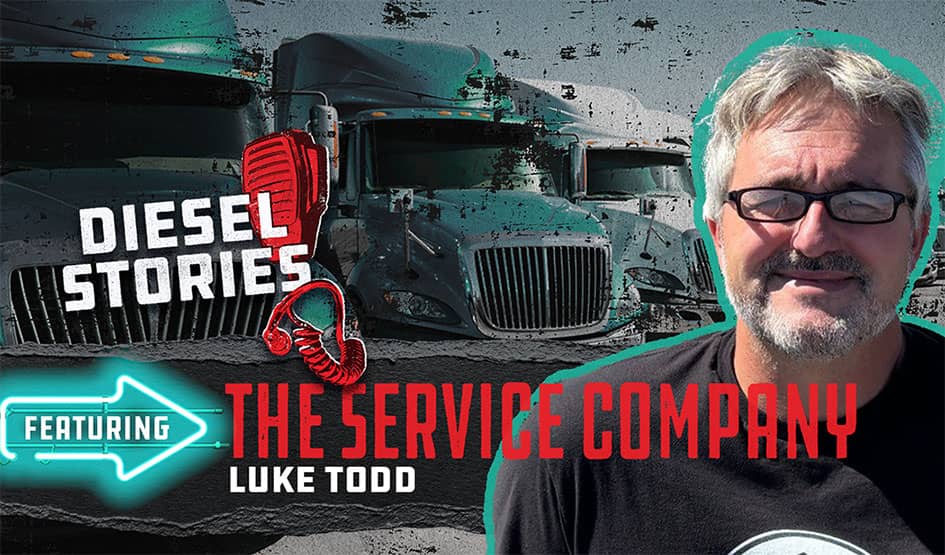
Who here remembers Diesel Stories?
If you don’t, that’s okay. It’s been a hot minute since an episode dropped. You know how it is: life gets busy, distractions pile up, and suddenly you’ve forgotten you even had a podcast. But lo, sound the air horns and cue the slow-motion montage, because Diesel Stories is back! Yes, friends, we’re back with more glorious tales of heavy-duty heroes.
In this episode, Peter Cooper of Ascend Consulting sat down with Luke Todd, President of The Service Company. Over the course of 45 minutes, they talked about how The Service Company decided to expand, what kind of metrics they track, and how running a more efficient shop can translate to running a more customer-centric shop.
As usual, we hope you’ll listen to the podcast. But if you’re short on time and looking for some new reading material, here are three of the most interesting takeaways!
When to Expand to a Second Location (And How)
At press time, The Service Company has four locations in the Dayton, Ohio, area. Three of them were built from scratch; the fourth they purchased last year.
What, Peter wondered, initially prompted them to open a second location in the early 2000s? Were they trying to tap into a new market?
“We were landlocked,” Luke explained. The shop needed more space, but it had no more room to grow, and they couldn’t purchase more land in the immediate vicinity. They also didn’t want to up and move, as they did like their location.
They noticed they had a number of customers living in a certain area. Huh, they thought, what if we tapped into that? So, The Service Company bought some land in that area and opened their second shop, reasoning that the customers who were from there would go to that shop instead, easing the workload on the mother shop. They’d take care of more customers by serving two regions.
“It sounded like a great idea,” Luke said.
While some customers did switch to the second location, most were already pleased with the first, and so the workload didn’t split down the middle. They grew the second shop instead.
Luke was a technician at that point, and didn’t have the intel on the shop’s inner workings that he does now. But he does recall the emphasis on efficiency — “Our actual on-job hours vs. what we bill” — and how their high efficiency led to the necessary capital and manpower to open that second spot.
“You Have to Know Where Every Minute Goes”
So, with four locations and close to 30 employees, what metrics are Luke and The Service Company using? Efficiency is still a big one, but there’s a second, equally important metric to keep an eye on: utilization.
Utilization means different things to different people. To the Todds, “The way that we use it in our comp utilization is the amount of time that technicians are clocked in versus the amount of time that they are clocked on to jobs,” Luke explained. “I like looking at both pieces of it: utilization and efficiency.
“You have to know where every minute goes,” he went on.
Hey, labor is expensive. Think of it this way: If you’re charging $120 an hour, that boils down to $2 a minute. If you’re charging $180, it goes up to $3 a minute. Knowing where your time is going is absolutely mission critical to running a successful operation — if you have ten technicians but they’re only 80% efficient and 80% utilized, well, you could generate the same amount of revenue with six fully efficient and utilized techs.
But Fullbay, you might be saying, stuff happens that cuts into both. What if they have to wait for parts?
Fear not, alert readers. The Service Company has a policy for that.
A Tech’s Time Matters
“We keep our bolts in the shop,” Luke said. “Bolts, nuts, all that hardware. You don’t go through a parts person to get [them].”
Say it with us now: Whoa.
Yes, there will be different opinions on how good of an idea this is. But it works for them. “Techicians can have a tenancy to use things and maybe not write them down,” Luke said. For The Service Company, if a tech is spending three or five or more minutes waiting around for a 30-cent item, that wait becomes difficult to justify.
“Would you rather write off some hardware or some labor?” he asked. “My target’s always been … 100% efficiency. That means all the hours we’re working, we’re actually getting paid for.”
The lesson here: If you’re looking to get more efficiency out of your techs, make sure management isn’t inadvertently contributing to it. A tech can’t outrun poor service writing, for instance, or a service manager who gets in late and ends up spending ten minutes trying to get their work station in order before dispersing work.
If you’ve got six techs and they’re standing around for 10 minutes in the morning before they get something to do…well…that’s 60 minutes. You just lost an hour.
The Service Company has also had some luck in bringing in dedicated cleaners. “That doesn’t mean a tech can be a slob,” Luke clarified, adding that sometimes the techs do handle scrubbing down the bay. “But I’d rather [the tech] move on to the next unit than clean [the] bay.”
The efficiency and utilization Luke talks about aren’t just good for the shop — they’re good for the customer. It’s not just about getting a job turned around faster, although that certainly helps. A less efficient shop tends to have to charge more to deal with their overhead, because they have to work more hours to earn what they need to. A fully efficient shop can pay its bills with fewer clocked hours.
Go Listen to the Rest!
It may seem hard to believe, but the topics we described were less than half of the podcast! Peter and Luke covered a lot of ground, including:
- How The Service Company manages its overhead.
- How Luke gets buy-in from employees.
- What other metrics and numbers shop owners should be looking at.
- …and more!
Go and give the episode a listen and take some notes! And welcome back, Diesel Stories. We missed you!

Get news & tips Right in your inbox.