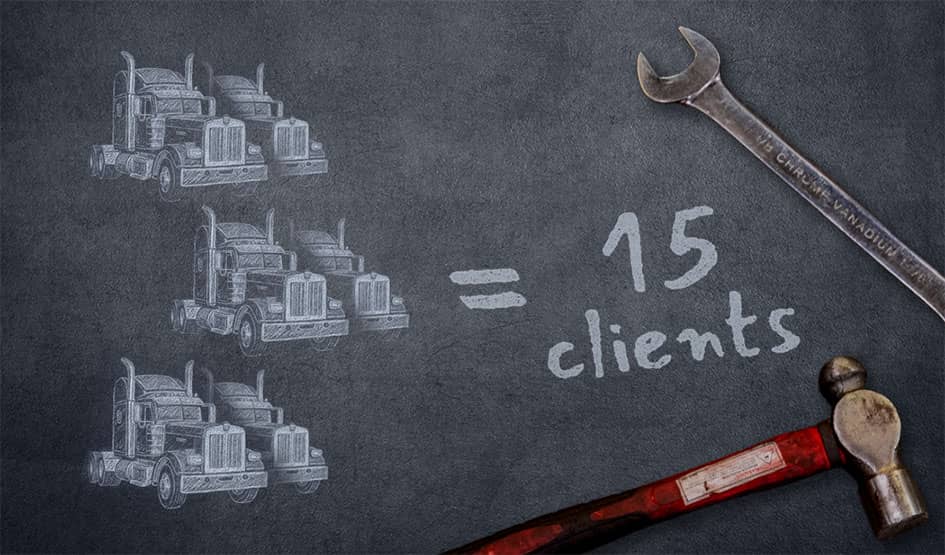
The Impact of NSPs: It Can Take 15 Clients to Replace 3 Fleet Accounts
Summary: National service providers (NSPs) are changing how fleets handle maintenance — prioritizing automation, centralized systems, and simplicity over local relationships. Independent shops aren’t out of the game, but they do need to adapt.
Read on to learn how fleets are consolidating vendors; how shops are competing with systems — not just other providers; and potential paths forward — level up with tech, go niche, or plug into larger networks.
It’s not a story any shop owner wants to tell: three fleets bidding them adieu within the last year.
Not because of its pricing.
Not because of the quality of work.
No, those customers left because a shift happened at the corporate level; one that ended with the fleet dropping independent shops in multiple regions for national service providers (NSPs) — large, multi-location or network-based maintenance companies offering centralized billing, automation, and reporting across multiple locations.
That was the story Andrew B. brought to fellow mobile and roadside repair owners over at the Diesel Community. “It will take finding 15+ smaller customers to replace the ones I lost,” he lamented. “I just don’t know how a family-owned business can compete anymore.”
It’s not a position anyone wants to be in, but a lot of folks have been there. Andrew B. received some commiserating and encouragement, along with a few new routes to try.
It’s Not Just You
Other owners immediately chimed in. It’s not just you, they said. Multiple shops have seen similar shifts, mostly thanks to things like corporate consolidation and the loss of internal fleet managers. As those roles disappear, fleets are turning to NSP networks to handle the coordination and tracking that those employees once managed.
“When Big Corporate calls for cuts,” Terri N. said, “you can’t compete.”
And look, NSP networks have their perks. They offer centralized billing and standardized reporting, which can make life a lot easier for those managing assets across multiple locations. Working with one vendor instead of a bunch of independents can be much simpler, especially when there’s no one left in-house to deal with the details.
It is, unfortunately, the reality independent shops are dealing with.
How Can Independent Shops Fight Back?
Use Technology to Match What National Service Providers Offer
One of the most prominent suggestions was for shops to take a hard look at their tech stack and level up if need be. NSP networks are largely digitized; they utilize telematics and portals, along with predictive maintenance. The good news is that those tools are hardly out of reach for independent shops.
(Really! You can get all of them with Fullbay!)
With the right setup, you can offer automated maintenance tracking and faster approvals and communication. That, in turn, can lead to a bigger shift: how you position your shop.
How to Market Your Independent Shop to Fleet Clients
Instead of talking up the way you handle repairs — because everyone handles repairs — start talking about outcomes. Position yourself as master of:
- Uptime (fleets love uptime).
- Visibility.
- Management.
Or, to paraphrase a couple of shop owners, start thinking less like a repair shop and more like a fleet management partner.
Specialty Equipment Repair: How to Win Fleet Work National Providers Won’t Touch
Other respondents suggested fighting back in another way: going niche and charging for it.
This could look like focusing on specialty equipment and hard-to-service vehicles. “Find something you love or a specific customer need, something that the national guys don’t touch or shouldn’t touch,” Bobby C. advised. “I found RVs and buses,” Peter C. added. “Most hate them. I love them … when you can charge [twice] your normal labor rate, you can learn to like working on just about anything.”
Terri N.’s shop, though, wins the prize (in this writer’s eyes) for “Most Interesting Equipment Serviced”:
- Roofing equipment.
- Airport equipment.
- Cryogenic equipment (!!!!).
Labor rates for those areas, she reported, are way higher than for regular work.
Joining Fleet Service Networks as an Independent Shop: What to Know
There is another option: You can join the NSP party if you really want to.
There are networks and programs out there that offer a kind of national footprint without requiring you to join a franchise or otherwise give up your independence. Organizations like AMBEST, HDA Truck Pride, and others allow independent shops to access corporate billing structures and participate in larger fleet contracts that might otherwise be out of reach.
Another option is to become a vendor for a national provider or maintenance management company (FleetNet America, for example). Even if you’re no longer the primary service provider for a fleet, you might still be able to snag some of the work by handling overflow jobs and coverage gaps.
That move may not be for everyone, though — some shops truly value their independence and aren’t particularly interested in joining a nationwide network. If that’s you, you still don’t need to despair. Bobby C. counseled patience, and shared that he’s currently taking on spillover work from a national provider that couldn’t complete a repair themselves.
“Take those ‘lost’ customers a box of donuts,” he said. “They will be calling you soon.”
What Do You Think?
Do you have thoughts on NSPs snatching work from independents? Got any ideas on how to wrangle that work back? Join the conversation! Head over to Fullbay’s Diesel Community and see what other shop owners just like you are talking about. It’s free, and the conversation is just getting started.


Get news & tips right in your inbox.