Why Buying a Shop Beats Starting One (And Other Heavy-Duty Lessons): A Diesel Stories Recap
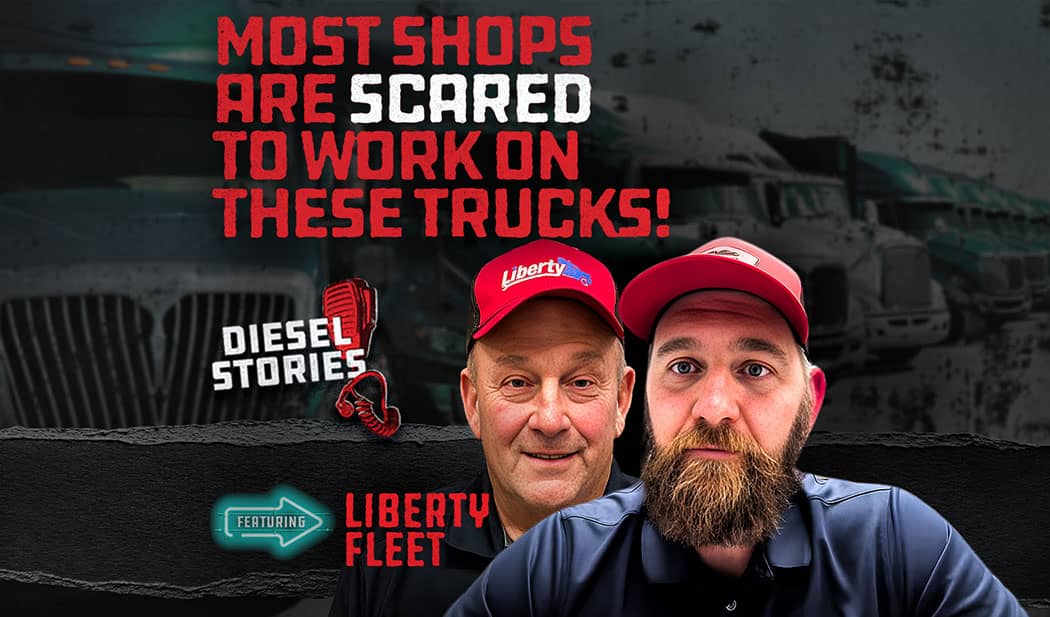
Summary: Liberty Fleet Solutions didn’t start out with a grand plan; it began with a layoff and a need to survive. Decades later, it’s a multi-generational shop, and both Bob and Bobby Chambers sat down with Peter Cooper to talk about growth, leadership, and what works (and doesn’t work) in the real world. They dig into why buying an existing shop can be way easier (and faster) than starting one from scratch, and what the rise and fall of a second shift reveals about leadership and shop culture. They also talk about how giving techs a sense of purpose can drive better performance.
Hey there, Fullbay folks! We’re back with another Diesel Stories recap. In this episode, Peter Cooper of Ascend Consulting sat down virtually with Bob and Bobby Chambers of Liberty Fleet Solutions (née Liberty Equipment) and talked with them all about running a shop, dealing with employees, and buying up real estate.
Yep. Real estate.
Liberty Fleet Solutions arrived on the scene in the 1980s, when Bob Chambers was laid off from his construction job and decided to create his own work instead of finding another employer. “It was a way to make a living and keep food on the table,” he said, and what started as side jobs to stay afloat gradually grew into a full-fledged diesel repair business.
Over the last few decades, Bob and Bobby have grown it into a multi-generational shop that now specializes in fleet services with a niche focus on — wait for it — fire trucks.
You should probably watch/listen to the entire episode, which is up on YouTube. Or, if you’ve only got a few minutes, give our recap a read and see what we thought was most interesting.
Buying A Shop Is Way Easier Than Starting From Scratch
Buying and selling shops isn’t new, but it’s not something we talk much about here on Fullbay (well, aside from this one article). But the Chambers clan (and Peter) agree: starting a shop on your own, from nothing, is absolutely possible…but man, it’s brutal, and a drain on your resources and time.
There’s a way around it, though: acquiring an existing shop.
Yep.
We’re putting this information right at the top, because, as Bob said, it’s a message they think people should hear.
“It is ten times easier to take a poorly run or even a well run business than it is to start from zero,” said Bob. Purchasing an existing shop — even one that may be struggling — can dramatically accelerate your growth, because you’re buying an entire existing operation. It already has:
- Customers (well, hopefully).
- Technicians and staff.
- Equipment and trucks.
- Shop software, scheduling, and workflows.
Now, some of these things may not be in spectacular shape, but think of it mechanically: is it easier to fix some problems on a truck, or build one from scratch? (Yes, we know this is a dramatic example.) Both are possible, but in 90% of cases, it’s going to be less expensive and mentally grueling to fix the existing truck than to get a new one put together on your own.
If you’re a tech interested in starting your own shop, Peter said, you can even look into purchasing the one you work for. Just asking an owner about succession plans can get people thinking, as a lot of shop owners don’t even start thinking about retirement until a back gives out. (We joke [a bit], but per the latest State of Heavy-Duty Repair report, 49% of shops don’t have any sort of succession plan in place at all. And honestly, that’s something shop owners need to think about, for the good of their families and for their employees.)
And look, retirement is no joke. Bobby points out how much work goes into just getting a shop off the ground and then running it. And then they spend decades paying rent. “Twenty, 30 years goes by really fast,” he said, “and you’ve paid the rent, and that building could have been your retirement.”
Buying a shop, Peter concludes, is like “the best savings account you can ever have.”
Second Shift Can Be Awesome…until It’s Not
The second shift is an appealing direction to take your shop in, if it’s something you can swing. After-hours work can definitely unlock new revenue streams (preventive maintenance services! Fleet work! The whole shebang!) but it takes a lot of planning to execute properly.
Liberty Fleet Solutions started their second shift last year. It ran from 2:30 PM to 11 PM, and the plan behind it was two service trucks (each with a team of techs) and scheduled maintenance work. They’d go out to a customer’s lot and do DOTs on all the trucks, as well as basic maintenance: think tires, brakes, and so on.
And for a while, the experiment ran quite well. They ran into some expected pitfalls; parts suppliers aren’t exactly open late, for example, so it took more planning and coordinating. “If you’re out there at nine o’clock at night and you realize you got the wrong fuel filter, you don’t have a lot of options,” he said.
Okay, the parts situation would get annoying, but aside from that, what was the downside?
Ultimately, it came down to leadership. “It was really hard to find solid leadership who wanted to work those hours,” Bobby said. “We actually had a guy that was stealing from us at one point and, basically, taking our calls and giving them to another company.” And on top of that, he added, some team members started losing trust in each other. It’s hard to function well as a team when you don’t trust the person beside you.
That distrust ended up spreading to the day shift, too, as techs came in for the morning shift and complained about things that had or hadn’t gotten done the night before. Once things reached that level, Bobby and his team decided to suspend the second shift for the time being, as it’s hard to regain that kind of trust.
Remember The Work Has Purpose
The conversation eventually touched on purpose, and why that’s important in a shop.
“All employees want to know that the work has meaning,” Bobby remarked. They want to know they’re rowing towards, for want of a better phrase, a worthy goal. They’ve got that for sure at Liberty Fleet Solutions, which works on fire trucks — they know that once those vehicles leave the shop, they’re going to be out there stopping fires and saving lives in their community.
They’re contributing to something important, and they work that much harder because of it.
But Fullbay, you might be saying, I don’t work on fire trucks…how can I get that kind of hard work from my people?
Well, look at it this way: what are the trucks they’re fixing doing? Probably ferrying goods of some sort, right? Everything shows up on the back of a truck. It might be hauling building materials, medicine to those who need it, and hazardous waste away from where it can cause harm.
“I think that gets lost a lot in our modern age; we’re focused on revenue. We’re focused on money,” Peter said. “We have to be able to keep the doors open. But how often do shop owners really stop and think, ‘What is our purpose? Like, what are we trying to do here?’”
There’s Plenty More Where That Came From
While we found these highlights fascinating, the team covered a lot more ground. You should definitely check out the rest of the episode to learn:
- How the shop got involved with fire trucks in the first place, and what kind of requirements that entailed (we also discuss this in a prior article!).
- How Liberty Fleet Solutions approaches hiring (and where they find techs — always a hot topic for Diesel Stories).
- What kind of issues can develop when you attempt to be a one-stop shop for your customers.
You should definitely go listen to the entire episode, which runs just under an hour. Or, y’know, you can catch up on prior episodes and see how other shop owners have started and grown their operations.


Get news & tips Right in your inbox.