Trailer Repair Shop Software: How to Protect Your Parts Margin
Key Takeaways
- A parts price that moves between quote and invoice comes straight out of your margin, and most shops only notice it after the job is invoiced.
- Look for cost tracking on every purchase, purchase history by part and vendor, and pricing rules you set once.
- You can start before you buy anything. Audit your last 10 service orders, then track quoted versus actual cost for two weeks.
- When you shop for software, ask how it handles cost changes. Ask whether you can see what you paid last time by vendor, whether you can set markup by part price and customer, and whether it flags a job that falls below your profit target.
It starts with a routine job. A trailer rolls into your bay, and you fire off an estimate based on the last set of parts you ordered. The customer gives you the nod. You order the parts.
Then the invoice lands. The price has jumped since you quoted it.
You cover the difference. Your margin? Gone.
If that hurts, you’re not alone. Parts pricing volatility is a hidden drain on profit in trailer repair. It doesn’t show up as a line item on your P&L, but it cuts into your margin on every job. Many shop owners are only finding out about it when the numbers don’t add up weeks after the job is invoiced.
No software will lower parts prices. But the right trailer repair shop software can show you what you paid, what you charged, and where margin is slipping on every service order.
Why Trailer Parts Prices Don’t Sit Still
Everyone knows supply chains have been rough. The conversation usually stops at “parts are hard to get.” But the price of the parts you can get rarely sits still. Trailer shops buy a wide mix of parts, from brakes to lighting, suspension, and reefer unit parts, and each one moves on its own schedule.
- Commodity swings: Steel, rubber, and copper prices move on global markets. That can show up in what you pay for brake drums, tires, and wiring.
- Spot rates vs. contract pricing: If your regular supplier is out of stock and you have to buy elsewhere, you pay whatever that vendor charges that day.
- Supplier price increases: Vendors pass along their own cost increases, often with little notice. A part that was one price last week can cost more this week.
Across a full month of service orders, those small per-part swings add up to real margin you never see again.
What Price Swings Do to Your Shop’s Bottom Line
Price swings cost more than a single bad estimate. Here’s how it adds up:
- Lost margins on fixed-price quotes: You quoted a job based on last week’s price. The parts cost more today. You lose the difference.
- Time spent calling customers back: If you catch the price change before ordering, you have to call the customer and ask for a re-approval. That eats into your day and frustrates everyone.
- Write-offs on unreturnable parts: You ordered a part for a job that changed or fell through, and now you’re stuck with it. Either you can’t return it, or the restocking fee eats your margin.
- Delayed service orders: Chasing a better price can hold up a truck for hours, costing you bay time and customer trust.
Here’s an example. Plug in your own shop’s numbers:
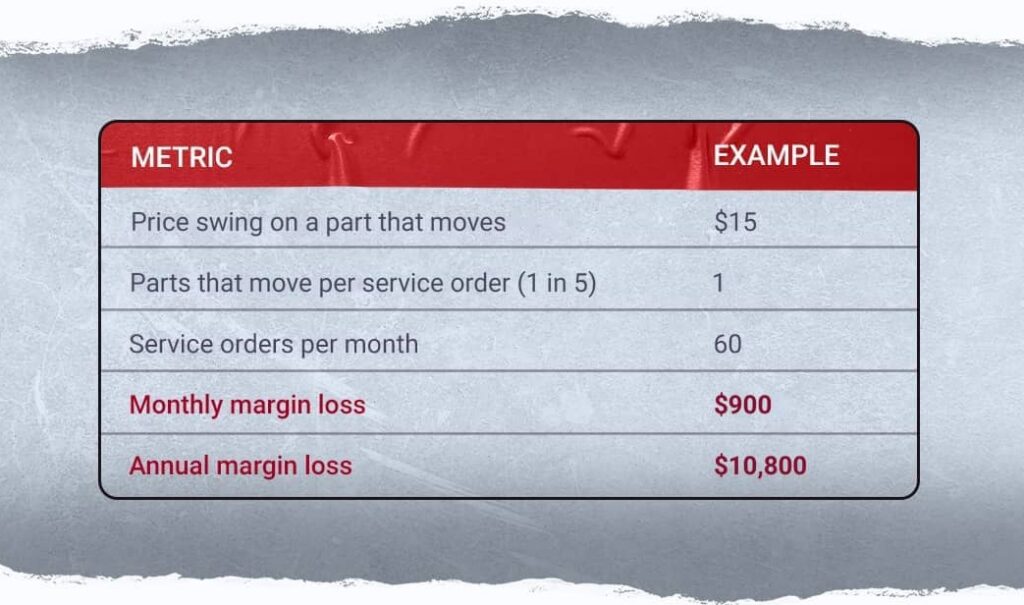
Over a full year, that adds up to real money you earned but never saw. This example assumes every part moves against you, so treat it as a worst case. And it only counts parts, not the labor and overhead tied up in the chaos.
Why Your Current System Can’t Keep Up
If you’re still using paper, whiteboards, or generic auto-repair software, you’re working blind. Here’s why:
- Manual price lists are outdated the moment they’re printed. Your parts manager might be checking a catalog from three months ago.
- Relying on memory is a losing game. “I think that part was around $200 last time” won’t protect your margin.
- Generic auto software isn’t built for heavy-duty shops. Trailer parts are different, with multiple axle types, wheel-end configurations, and regulatory components. A brake drum for a 53-foot reefer isn’t a passenger car part, and your software shouldn’t treat it like one.
You might be thinking, “But Fullbay, my shop has done it this way for 20 years. We know our parts.”
We hear you. You probably do know your parts better than anyone. But prices have changed. What worked in a stable market doesn’t work when prices move often. The question isn’t whether your team is good; it’s whether your system gives them the numbers they need to protect your margins.
What Shop Management Software Can and Can’t Do About Parts Pricing
No shop management software is going to magically lower your parts costs. It won’t negotiate with your suppliers for you. What it will do is give you the visibility and discipline to make better decisions.
Here’s what to look for in a heavy-duty repair shop software solution:
- Cost tracking on every purchase: The system should record what you pay for every part, every time you buy it. Over time, you can spot trends like which parts jump around, which suppliers hold steady, and where your margins get squeezed.
- Purchase history by part and vendor: Before you quote a job, you should be able to look up what you paid for that part and who you bought it from. That data is power.
- Automatic pricing rules: You should be able to set your pricing rules once, by markup or margin, and the system prices every part the same way on every estimate. A profitability view on each work order should break out labor and parts so you can check margin as you go, and reports should show how your margins are tracking over time. No surprises.
- Integration with your parts vendors: Yes, this can be complex. Not every supplier has clean data. But even manual entry of PO data into a good system will give you visibility you don’t have today. Fullbay Marketplace, for example, lets you compare price and stock across 40+ vendors.
You can’t eliminate parts pricing volatility, but you can see it before it hurts you.
Three Steps Your Shop Can Take Right Now (Before You Buy Anything)
You don’t need new software to start getting a handle on parts pricing. Here are three steps for this week:
Step 1: Audit your last 10 service orders. Pull the parts cost you quoted vs. what you actually paid. Add up the difference. The total might surprise you.
Step 2: Track price spikes manually for two weeks. Use a simple spreadsheet. Every time you order a part, write down the quoted price and the actual cost. Look for patterns. Does one supplier change prices more than others? Are certain part categories (brakes, lighting, reefer unit parts) worse than others?
Step 3: When you shop for software, ask the right questions. Don’t just ask “Does it integrate with my parts vendors?” Ask: “How does your system handle parts cost changes? Can I see historical pricing per part? Does if flag a job when profit falls below my target?”
The right answers will tell you whether the software company understands your real problem.
Protect Your Margin With the Right Trailer Repair Software
Parts pricing volatility will keep cutting into your margin. That won’t change. Supply chains will keep shifting, and commodity prices will keep moving. But you don’t have to keep absorbing the hit.
The right mechanic shop software gives you the data to quote with confidence and protect your margins, so you’re not leaving money on the table.
That’s why Fullbay was built specifically for heavy-duty repair, not adapted from generic auto software. We know the parts grind. We built tools for it.
FAQs
Q: Can software really help me negotiate better parts prices with my suppliers?
A: Not directly. But it shows what you’re paying per part and how much you buy from each vendor, which strengthens your hand when you ask for a better rate.
Q: Won’t adding software just create more data entry for my parts manager?
A: Only if the software isn’t built for heavy-duty use. Good trailer repair shop software lets you add parts, order them, and add them to a purchase order right from the work order, so nobody enters the same thing twice.
Q: What if my parts supplier doesn’t integrate with the software?
A: Many shops enter PO data by hand, and the software still tracks what you pay for each part, and your reports show your margins. Integration is ideal but not a prerequisite for gaining parts visibility.
Q: How often do parts prices change? Is it really that volatile?
A: It depends on the part and the supplier. Some prices hold for months. Others change with the next order, especially during supply crunches. Your own purchase history is the best way to see which is which.
Q: I know my margins are eroding — but is parts pricing really the biggest factor?
A: It’s one of the toughest things to control. Labor rates are mostly fixed. Parts prices are not, so this is often where margin slips fastest.
See what you paid for every part before you quote the next trailer job. Book a free demo of Fullbay. We’ll show you how our heavy-duty shop management software helps you track parts costs and set pricing rules that protect your margins.

Get news & tips right in your inbox.